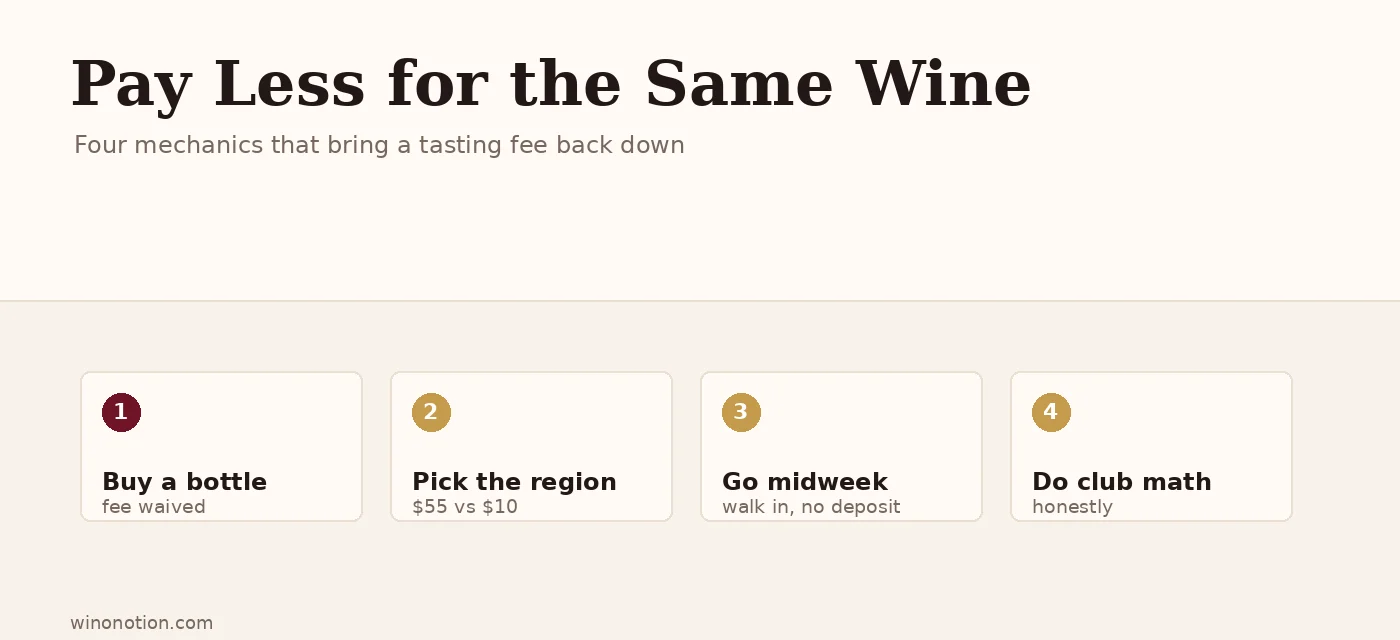
How to Pay Less for the Same Wine
Tasting fees have climbed everywhere. Four mechanics reliably bring them back down, and most visitors use none of them.
1. The fee that refunds itself
The single best deal in wine is the waiver: buy a bottle and the tasting fee comes off the bill. It is common, rarely advertised, and turns a $10 or $20 tasting into a free one for anyone who was going to buy wine anyway.
We have verified the policy at wineries including Rippey at Lodi Vintners, Spenker Family Farm, Nostra Vita Family Winery, St. Jorge Winery, Block 21 Winery, Viaggio Estate & Winery, GoodMills Family Winery, Sunset Suisun, Arroyo Cellars. Lodi and Oregon are where we find it most often, though that partly reflects which regions publish their terms clearly.
Ask before you sit down. The answer is yes more often than the price list suggests, and it sometimes scales, with a two-bottle purchase covering a party of four.
2. Choose the region, not just the winery
The fee you pay is mostly a function of geography. Napa's median published tasting fee is $55; the Sierra Foothills is $10, Paso Robles and Temecula are $15, and Lodi is $10. Three stops for two people is $330 in Napa and $60 in Lodi.
That is not an argument against Napa. It is an argument for building a trip around one splurge and several bargains, which we worked through in The Value Belt and the fee report.
3. Go on a weekday, and go early
Weekday visits are cheaper in ways that do not appear on a price list: more attention from whoever is pouring, a better chance of the winemaker being around, easier reservations, and a far better chance of a comped extra pour. Several wineries also discount weekday tastings outright.
Walk-in rooms are the other half of this. We track 851 wineries that welcome visitors without an appointment, which removes both the deposit and the pressure to arrive on schedule. Open the map filtered to walk-ins to plan a day you can improvise.
4. Do the club and pass arithmetic honestly
Wine clubs waive tasting fees for members and their guests, which is genuinely valuable if you visit the same winery more than twice a year and a poor deal if you do not. Work out the real number: annual shipment cost against how much of that wine you would have bought anyway, plus the fees you would actually avoid.
Regional tasting passes work on the same logic. They pay for themselves quickly if you are doing a concentrated multi-winery trip, and not at all if you taste twice.
What not to do
Do not skip the fee by tasting and leaving with nothing when you liked the wine. In a small winery, the tasting is a cost centre and the bottle is the business; the fee exists because too many people treated the room as a free bar. The waiver is the industry offering you a deal, and taking it is how the arrangement keeps working.
A note on the numbers
Fee medians come from 1,410 wineries publishing a specific price. The waiver examples are wineries whose refund policy we have verified and dated; many more offer one without publishing it, which is exactly why asking is worth the ten seconds. Confirm current terms with the winery before you travel.
Published September 2026.