What 6,054 Tasting Rooms Say About the Price of a Pour
The trade press has spent a year asking why Napa tasting rooms are struggling. We went and counted what wineries across the country actually charge. The answer is that most of American wine country never had the problem.
The number that starts the argument
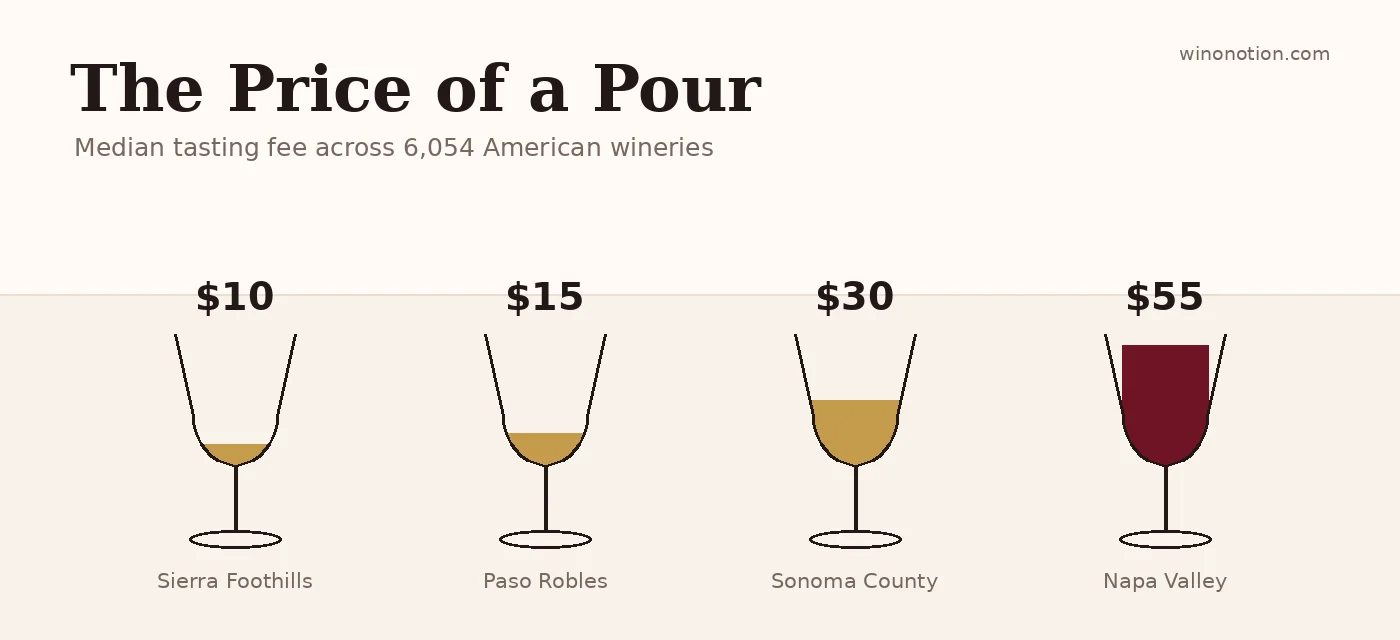
Among the wineries in our catalog with a published tasting fee, the median in Napa Valley is $55. In the Sierra Foothills, a two-hour drive east, it is $10. Paso Robles and Temecula both sit at $15. Sonoma, which shares a county line and a grape variety list with Napa, comes in at $30.
That is not a small gap. It is the difference between a spontaneous afternoon and a planned expense. A couple visiting three Napa rooms will spend more on the privilege of tasting than on a decent dinner, before buying a single bottle. The same couple in the foothills can taste at three wineries for the price of one Napa flight and still leave with wine.
Median published tasting fee, by region
| Region | Median fee | Wineries counted |
|---|---|---|
| Napa Valley | $55 | 438 |
| Oregon | $35 | 49 |
| Sonoma County | $30 | 346 |
| Santa Barbara | $25 | 51 |
| Mendocino | $20 | 26 |
| Santa Cruz Mountains | $20 | 29 |
| SLO Coast | $20 | 36 |
| Paso Robles | $15 | 209 |
| Temecula Valley | $15 | 38 |
| Sierra Foothills | $10 | 67 |
Medians calculated from 1,410 wineries that publish a specific tasting price. Regions shown have at least 25 such wineries. Where a winery offers several tastings, the entry-level price is used.
Most tastings in America are still cheap
Read the industry coverage and you would think the $75 flight is standard. It is not. Of the wineries we counted, 504 charge $20 or less and 461 charge between $21 and $40. Only 46 charge more than $75. The expensive, seated, ninety-minute experience that dominates the conversation is a real thing, but it describes a small and geographically concentrated slice of the country.
What this means for a visitor is simple: the fee you pay is mostly a function of where you point the car, not of how good the wine is. Some of the most interesting bottles we have tasted this year came out of rooms charging $10 to $15.
The fee that gives itself back
The most visitor-friendly policy in wine is the waiver: buy a bottle, and the tasting is free. It rewards the people most likely to become customers and it removes the sting of paying to sample something you might not like. Berghold in Lodi does it. So does Wellington in Sonoma Valley, where a purchase covers the fee outright.
The waiver is also the quiet argument against high fees. A winery charging $75 has made the tasting itself the product. A winery waiving $15 has made the wine the product. Both are legitimate businesses. Only one of them is easy to say yes to on a Saturday afternoon with three more stops planned.
What we would tell someone planning a trip
Budget by region, not by reputation. If you want the full Napa experience, book one or two rooms there and build the rest of the trip somewhere with a lower entry price. The Sierra Foothills, Paso Robles, Temecula, Lodi and the Santa Cruz Mountains all deliver serious wine without the seated-tasting premium.
Ask about the waiver before you sit down. It is often unadvertised, and it changes the math on buying a bottle you already liked.
And use the walk-in filter. We track 851 wineries that welcome visitors without an appointment, which is the other half of what makes a wine day feel relaxed rather than scheduled. You can see them on the map, or browse by region in the winery finder.
A note on the numbers
These figures come from our own catalog of 6,054 American wineries. Fees are published prices gathered from wineries and regional sources, not from a survey, and 1,410 of those wineries publish a specific price we could verify. Coverage varies by region, so the table above is limited to regions where we hold at least 25 verified prices. Prices change constantly. Confirm with the winery before you travel, which is advice we would give even if we had checked yesterday.
Related: The Value Belt looks at what the same Saturday costs in Lodi and Suisun Valley versus Napa and Sonoma.
Published September 2026.