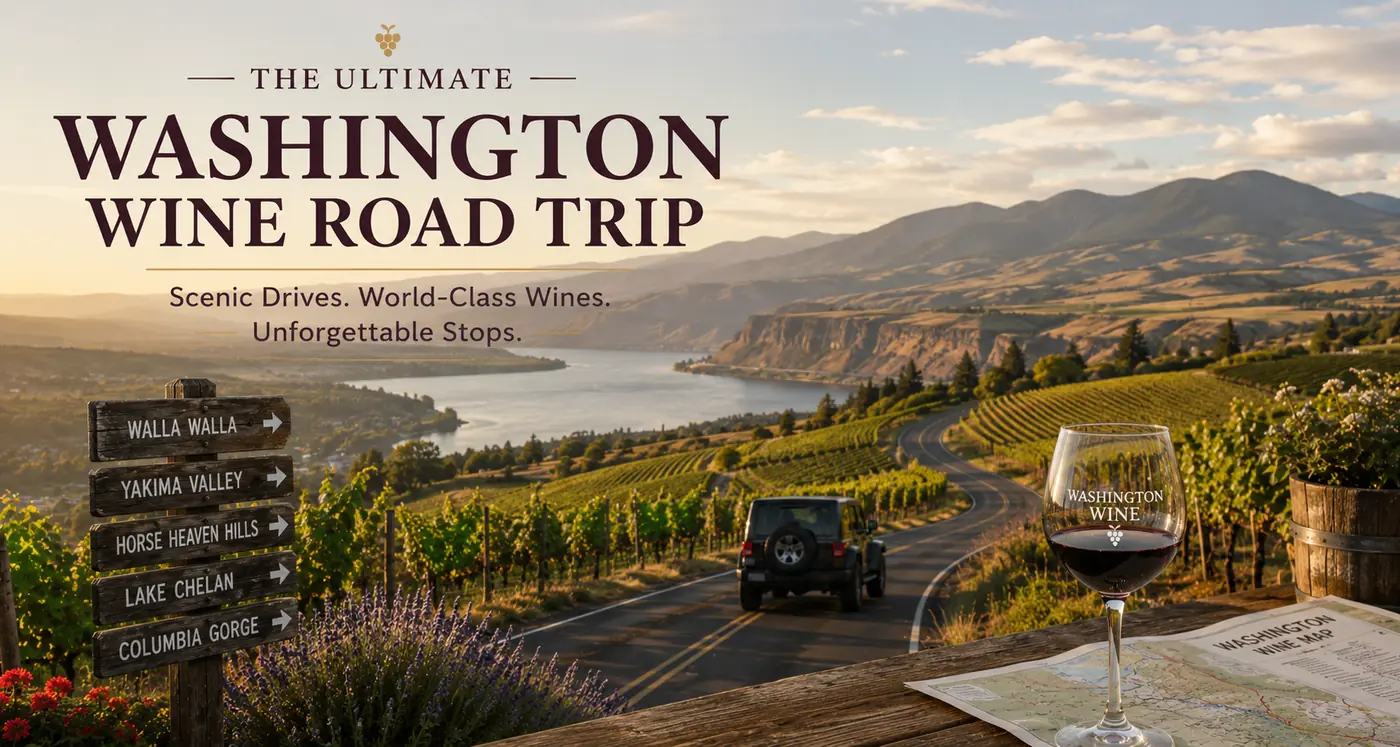
Washington is the second largest wine producer in the United States, and almost nobody road-trips it the way they road-trip Napa. Part of the reason is geography: the good stuff is spread across hundreds of miles of eastern Washington, on the dry side of the Cascades, and the regions are far enough apart that you have to plan rather than wander.
The payoff is that it stays uncrowded. Tasting fees run well below Napa, walk-ins are far more common, and you will regularly find yourself talking to the person who made the wine. This guide covers 327 wineries across the six regions worth routing a trip around, in the order that makes sense to drive them. Our full Washington catalog runs to 406.
The shape of the trip
Nearly everything of consequence happens east of the Cascade Mountains. Seattle and Portland sit on the wet western side, but the vineyards are in the rain shadow, where summers are hot, nights are cold and rainfall is measured in a handful of inches a year. That means every version of this trip involves crossing a mountain pass, and it means the weather on either side of that pass can be completely different on the same afternoon.
The standard route starts in Seattle, warms up in Woodinville, crosses Snoqualmie Pass to the Yakima Valley, then continues southeast to Walla Walla. From there you either turn back, or carry on west along the Columbia River through the Gorge and out at Portland, which makes a clean one-way loop if you can drop the car at a different airport.
The six regions, in driving order
1 Woodinville 74 wineries
Thirty minutes from downtown Seattle
The warm-up, and the only stop on this trip you can reach without leaving the Seattle metro. Woodinville is a tasting-room district rather than a growing region: almost all the fruit is trucked over the Cascades from eastern Washington, and what you get is a walkable concentration of rooms, from the landmark estates down to garage-scale producers in business parks. If you only have a day, this is the whole trip.
More: wine tasting deals woodinville
2 Lake Chelan 46 wineries
About 3 hours east of Seattle over Stevens Pass
A 50-mile glacial lake with vineyards running down to the shoreline, and the most scenic stop on the route by some distance. It is also the most seasonal: summer is busy and family-oriented, while September and October bring quieter roads, harvest activity and roadside fruit stands. Worth the detour north if you have the days.
More: wine tasting deals lake chelan
3 Yakima Valley 61 wineries
About 2.5 hours southeast of Seattle over Snoqualmie Pass
Washington's oldest wine region and the agricultural heart of the state, where vineyards share the valley with hop fields and orchards. The classic loop runs southeast from Yakima through Sunnyside and Prosser, then back via Toppenish. Approach it from the north on the Yakima River Canyon and you get one of the best drives in the state before you have tasted anything.
More: most scenic wineries yakima valley wine tasting deals yakima valley
4 Walla Walla Valley 93 wineries
About 4 hours from Seattle, Portland, Boise or Spokane
The destination stop, and the one most people build the trip around. The valley crosses the Oregon border and splits into several distinct districts, but the easiest introduction is downtown Walla Walla, where dozens of tasting rooms sit within walking distance of the restaurants. Book a room downtown and you can leave the car for a full day.
More: most scenic wineries walla walla best time to visit walla walla wine tasting deals walla walla valley
5 Columbia Gorge 32 wineries
About 1.5 hours east of Portland
The natural way to close a loop if you are flying out of Portland rather than Seattle. The Gorge straddles the Columbia River, so the appellation covers both Washington and Oregon ground, and the climate shifts dramatically over a short distance. Waterfalls and Mount Hood views come free with the drive.
More: wine tasting deals columbia gorge
6 Spokane 21 wineries
About 4.5 hours east of Seattle on I-90
Predominantly an urban tasting district rather than vineyard country, with rooms in downtown warehouses and converted civic buildings. Most fruit comes from the Columbia Valley to the south. A sensible add-on if you are driving through to Idaho or looping back from Walla Walla.
More: wine tasting deals spokane
Winery counts computed live from our catalog. Each region links to its full directory, scenic and deals pages where they exist. Browse everything at the Washington winery directory.
Practical notes
Mountain passes decide your route. Snoqualmie Pass on I-90 and Stevens Pass on Highway 2 both carry real winter conditions, and closures happen. Check state road conditions before committing, particularly between November and April.
Distances are bigger than they look. Seattle to Walla Walla is about four hours without stops. Yakima to Walla Walla is another two. This is not a region where you can improvise three tastings and a lunch across two areas in one day.
Fewer appointments, but still call ahead. Washington is markedly more walk-in friendly than Napa, especially in Woodinville and the Yakima Valley. The smaller Walla Walla producers are the exception, and many keep limited hours midweek.
Heat is the real seasonal factor. Eastern Washington summers regularly clear ninety-five degrees. If you are travelling with anyone who wilts in that, aim for late September or October, which is also when the cellars are busiest and most interesting.
Where to start if you only have a weekend
Pick one region and stay there. Woodinville if you want zero driving and a Seattle base. Walla Walla if you want the best wine and are willing to spend a day getting there and back. Yakima Valley if you want the middle ground, with real vineyard scenery and a shorter drive than Walla Walla.
For timing, see the best time to visit Walla Walla. For the coastal California equivalent of this trip, see our Highway 1 wine road trip, and for Napa's two main routes, the Highway 29 guide.
Frequently asked questions
How many days do you need for a Washington wine road trip?
Four days covers the core route comfortably: a day in Woodinville, a day crossing to Yakima Valley, two days in Walla Walla. Adding Lake Chelan or the Columbia Gorge pushes it to six or seven. A single weekend realistically means picking one region rather than driving between them.
What is the best time of year for Washington wine country?
September and October are the strongest months. Eastern Washington runs hot and dry through summer, often well into the nineties, while harvest season brings cooler air, activity in the cellars and quieter roads. Spring is pleasant but mountain passes can still see snow, so check conditions before committing to a route over the Cascades.
Do you need a car for Washington wine country?
For everything except Woodinville, yes. The regions are hours apart on interstate and two-lane highways, and there is no practical transit between them. Woodinville is the exception, reachable from Seattle by rideshare with tasting rooms clustered close enough to walk between.
Is Walla Walla worth the drive from Seattle?
It is roughly four hours each way, so it rewards a stay rather than a day trip. What you get is the state's deepest concentration of serious producers, with a downtown that puts dozens of tasting rooms and the restaurants within walking distance of each other.