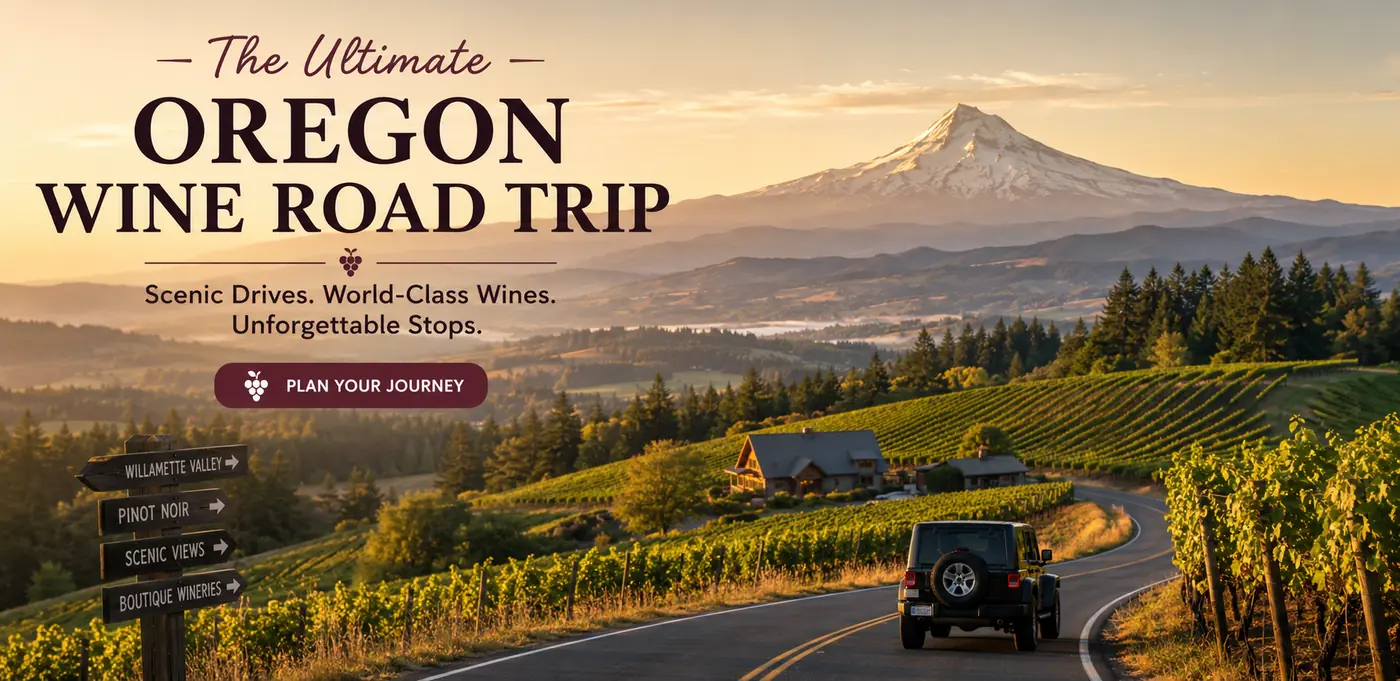
Most people who visit Oregon wine country drive forty-five minutes out of Portland, spend two days in the Dundee Hills, and go home. That is a perfectly good trip, and it is also about a fifth of what the state has.
Oregon runs nearly 300 miles from the Columbia River to the California border, and the wine changes completely along the way. The north is cool, wet and almost entirely devoted to Pinot Noir. The south is hot enough for Cabernet and Tempranillo, and looks more like northern California than like the Willamette. This guide covers 126 wineries across the six regions worth routing a trip around, north to south, the way you would actually drive it. Our full Oregon catalog runs to 190.
The shape of the trip
The spine is Interstate 5, which runs the length of the state, with Highway 99W as the slower and much prettier alternative through the northern wine country. Almost every Oregon wine region sits within about half an hour of I-5, which makes this one of the easiest wine road trips in the country to plan: you are essentially driving one road south and turning off it repeatedly.
The one exception is the Columbia Gorge, which runs east from Portland along the river rather than south. Treat it as a bookend, either the day before you head south or the day after you come back.
The six regions, north to south
1 Yamhill County and the 99W corridor 68 wineries
Under an hour from Portland
The heart of Oregon wine and the reason most people make the trip. Highway 99W runs southwest out of Portland and within forty minutes the suburbs give way to the Dundee Hills, where the concentration of Pinot Noir producers is the densest in the state. Newberg, Dundee, Dayton and Carlton sit within fifteen minutes of each other, which makes this the one leg where you can taste at three or four estates without a long drive between them. McMinnville is the practical base, with the hotels and restaurants.
2 Eola-Amity Hills and Salem 13 wineries
About 30 minutes south of McMinnville
Quieter and more pastoral than the Dundee Hills, with wind funnelling through the Van Duzer Corridor from the coast and cooling the vineyards. The drive south through Amity is the prettier way to get here. Salem itself is the state capital rather than a wine town, but it gives you somewhere to sleep between the northern and southern halves of the trip.
3 South Willamette and Eugene 8 wineries
About 1 hour 15 south of Salem
The valley narrows and the crowds thin out. This is the least-visited end of the Willamette and the stretch where you are most likely to have a tasting room to yourself. Coverage here is thinner than further north, so treat it as a stop on the way south rather than a destination in itself.
4 Umpqua Valley 6 wineries
About 1 hour 15 south of Eugene
The transition zone, where the cool maritime climate of the Willamette gives way to the warmer, drier south. That in-between quality is the whole point: growers here work with both Pinot Noir and warm-climate varieties like Tempranillo and Syrah on the same property, which happens almost nowhere else in Oregon.
5 Rogue Valley and Southern Oregon 25 wineries
About 2 hours south of Roseburg, near the California border
The warmest and most overlooked corner of Oregon wine, and the payoff for driving the length of the state. Forget Pinot Noir here: the Rogue and Applegate Valleys grow Bordeaux and Rhone varieties in a climate closer to northern California than to the Willamette. Jacksonville is a preserved nineteenth-century gold rush town and the most charming base on the whole route, with Ashland and its theatre festival twenty minutes away.
6 Columbia Gorge 6 wineries
About 1 hour east of Portland, a detour rather than part of the north-south run
Not on the I-5 spine at all, but the easiest add-on if you are starting or ending in Portland. The Gorge packs an extreme climate range into a short distance, going from wet and forested in the west to dry and open in the east, so the range of what grows here is unusually wide. Mount Hood and the waterfalls come with the drive.
Winery counts computed live from our catalog, grouped by verified town addresses. Some Oregon entries do not carry a parseable town and are not counted in the regions above - browse them all at the Oregon winery directory.
Practical notes
The rain is not a joke, and neither is the exception to it. The Willamette Valley is genuinely wet from November through May. But July through September is reliably dry and warm, which is precisely why the grapes ripen. Plan around that window if you can.
Tasting fees are far below Napa. Oregon remains one of the better value wine destinations in the country, and small-producer tasting rooms are often staffed by an owner rather than a hospitality team. Ask questions - you will usually get real answers.
Distances in the north are short, in the south they are not. Newberg to Carlton is twenty minutes. Eugene to Roseburg is over an hour, and Roseburg to Ashland is two more. Budget the southern legs as driving days with wine attached rather than the reverse.
Reservations vary by region. The well-known Dundee Hills estates increasingly want a booking, particularly at weekends. Southern Oregon and the Umpqua are far more relaxed about walk-ins.
If you only have a weekend
Stay in Yamhill County. Base in McMinnville or Newberg, taste in Dundee, Dayton and Carlton, and do not attempt to add Southern Oregon - it is four hours each way and you will spend the weekend in the car. Save the full north-to-south run for a trip where you have five days or more.
For timing, see the best time to visit the Willamette Valley and the most scenic Willamette wineries. For the neighbouring states, see our Washington wine road trip and the Highway 1 California route.
Frequently asked questions
How many days do you need for an Oregon wine road trip?
Three days covers the Willamette Valley properly, which is what most visitors come for. Driving the full length of the state down to the Rogue Valley is a five to seven day trip. If you only have a weekend, stay in Yamhill County and base yourself in McMinnville or Newberg.
What is the best time to visit Oregon wine country?
September and October, for harvest and the valley's most reliable stretch of dry weather. Summer is warm and pleasant but busier. Winter is the quiet season, when many Willamette wineries run what they call cellar season with fewer crowds and more time with the people pouring. Spring is green and wet, and the rain is real.
Is Oregon just Pinot Noir?
In the Willamette Valley, largely yes, along with Chardonnay, Pinot Gris and Riesling. But the south of the state is a different country: the Rogue and Applegate Valleys are warm enough for Cabernet, Syrah and Tempranillo, and the Umpqua Valley in between grows both cool and warm climate varieties on the same properties.
How far is Oregon wine country from Portland?
Closer than most people expect. The Dundee Hills, the centre of Willamette Valley Pinot Noir, are about 45 minutes southwest of Portland on Highway 99W. The Columbia Gorge is about an hour east. Southern Oregon is a different proposition at four to five hours south.