For two years, tasting-room reservations at Napa Valley's estate wineries have been sliding, roughly 2 percent a year,and the trade has mostly reached the obvious conclusion: fewer people are coming to wine country. The headlines have followed, framing the reservation data as proof that Napa visitation is in decline.
It's the wrong conclusion, and the gap between what the data shows and what it's being read to mean is one of the most important stories in wine right now. The reservation numbers only measure one thing, appointment-based tastings at estate wineries,and that has quietly become a smaller and smaller slice of how people actually experience the valley.
The visitors are here
Look at the measures that count actual bodies rather than booked appointments, and they point the other way. Napa County hotel room-nights rose in 2025 over prior years; the transient-occupancy tax those guests pay has climbed to record levels; restaurant employment has held steady; and the most recent visitor count put arrivals at 3.7 million. Within striking distance of the pre-pandemic high. Just as striking, the average visitor has gotten younger, dropping to around 40, and is spending more per trip, not less.
So why are reservations falling while every other number rises? Because reservation platforms can't see walk-in urban tasting rooms, pours at hotel wine bars, or the no-appointment estates like V. Sattui that draw enormous walk-in crowds. By one accounting, something like 40 percent of the valley's tasting capacity now sits in formats that leave no trace in reservation data at all. The wine is still being poured; it has simply dispersed into downtown First Street, Oxbow Market, restaurants, and hotel bars, where much of it never touches a booking system.
This is the heart of the argument vintner Ted Hall lays out in a recent essay (linked below), and it reframes the whole conversation: Napa doesn't have a demand problem. It has a share problem. The visitors are here; many estate wineries just aren't capturing them.
The real bottleneck: you can't tell them apart
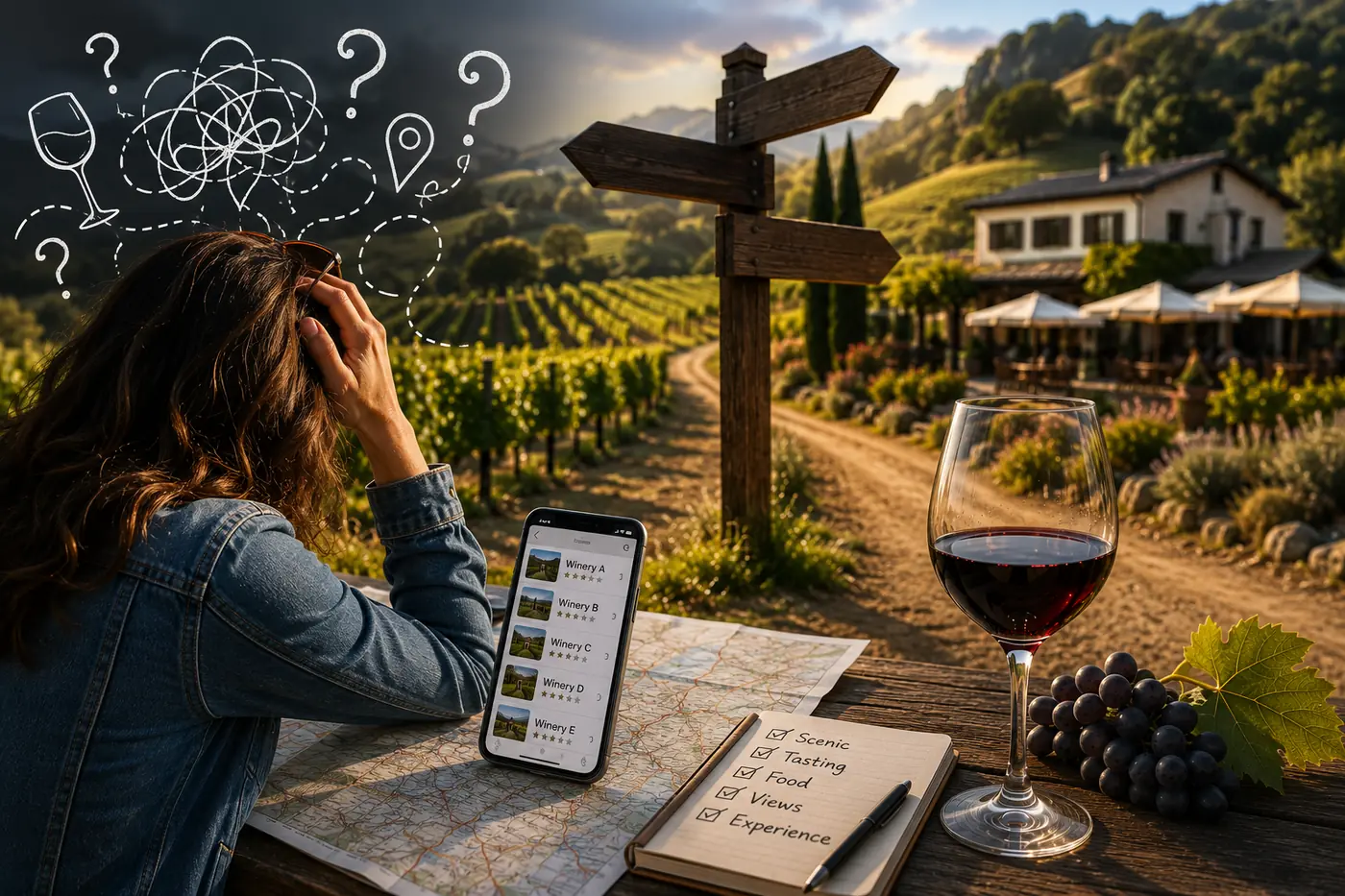
And underneath the share problem sits something even more fundamental, a discovery problem. There are more than 500 operating wineries in Napa Valley. Try to name 50 of them in ten minutes; most dedicated wine travelers can't. The names blur, and so does the marketing. Family-owned estate. Sustainably farmed. Small-lot Cabernet. Handcrafted with intention. By appointment. Exceptional views. Some version of that sentence appears on the majority of winery websites in the valley. Which means it does nothing to help a visitor choose between them.
Hall's analysis quantifies it bluntly: by one linguistic scoring of 500-plus Napa wineries, more than 70 percent cluster near an interchangeable, prototypical description, and fewer than 1 in 10 read as genuinely distinct. The wineries that do have a recognizable identity, a Corison, a Frog's Leap, a Spottswoode,are the ones a visitor can actually name, describe, and seek out. Visibility without differentiation, as he puts it, is just more noise.
That is a discovery failure as much as a marketing one. The visitor with two open slots on a Saturday isn't refusing to taste wine. They're standing in front of an undifferentiated wall of 500 options with no good way to choose, so they default to the names they already know and the walk-in spots a few steps from lunch.
Where Wino Notion fits, and where it doesn't
This is the layer we work on, so it's worth being precise about it. Wino Notion can't make a winery distinctive; only the winery can do that. What we can do is make the wineries that are distinctive findable, and help visitors choose the way they actually plan a trip, by what the visit is like rather than by parsing identical prose.
That's the whole idea behind our Vibe Finder. Instead of a directory of look-alike listings, it lets a visitor start from the experience they want, romantic, dog-friendly, good for a group, scenic, built around food and wine, family-welcoming, or a deep dive for the wine-obsessed, and surfaces the wineries that genuinely fit, each with a specific, grounded reason rather than boilerplate. It deliberately includes the walk-in-friendly and downtown formats the reservation data misses, because that's increasingly where visitors are. For a differentiated small estate, it's a way to earn a place on someone's itinerary on the strength of what makes it different, not the size of its ad budget.
We'll admit we learned the sameness problem from the inside. Building that tool meant reading thousands of winery descriptions, and an uncomfortable share of them were close to identical; the same boutique-Cabernet sentence, over and over. Cutting through that, and giving each winery a reason a real person can act on, turned out to be most of the work. It's also the entire point.
A better way to choose
The encouraging part of this story is that the customer Napa keeps worrying about hasn't disappeared. They're younger than ever, more diverse, spending more, and already in the valley. On First Street, at the food halls, at the music venues, driving past estate driveways without turning in. They will turn in for a winery that gives them a reason to. The job in front of the industry isn't conjuring demand that left. It's helping a distinctive winery and a curious visitor find each other in a crowd of 500, and that is a problem worth solving well.
The data and the demand-vs-share framing in this piece draw on Ted Hall's essay “Napa Valley: A False Signal” on his Substack, Tell the Truth and Do the Right Thing. It's well worth reading in full: Napa Valley: A False Signal.